
Has British train-building hit the buffers? (2004)

Skilled train builders are losing their jobs with the closure of the Washwood Heath factory. Has Britain’s train-building industry hit the buffers?
*
“My mother met General Montgomery during the war, when this place built Cromwell tanks,” recalls Don Evans, 56, who has worked at the Washwood Heath train building factory in Birmingham since 1968. “My father was a coachman here for forty-six years,” adds Evans.
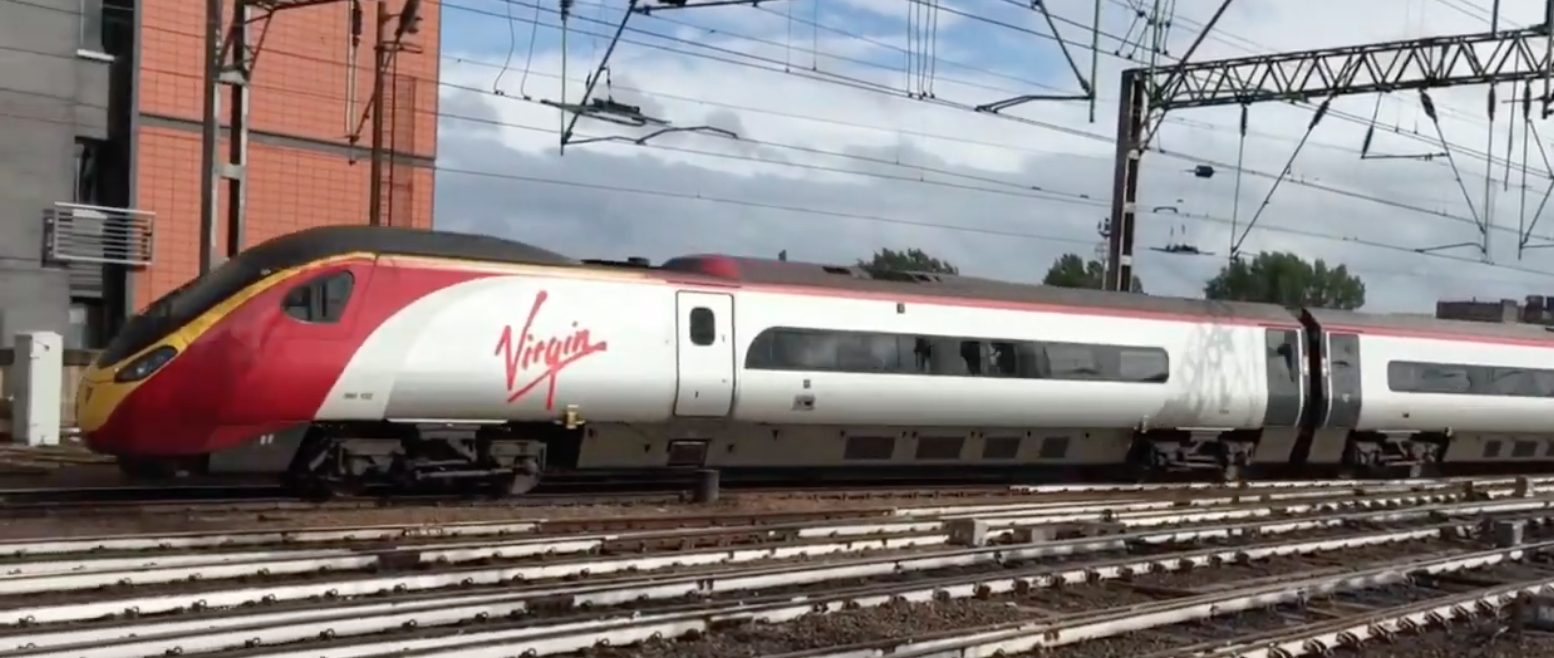
Evans (above right) painted signs for the £11 million, 125 mph, tilting Pendolino trains destined to speed passengers along the West Coast Main Line between London and Glasgow.
Alstom Transport’s Washwood Heath plant, where generations of local people have been building trains for 150 years, is just completing a £1 billion order of 53 Pendolinos for Sir Richard Branson’s Virgin Trains.
Evans met Branson in April, when the entrepreneur inspected one of the last Pendolinos rolling along the production line. “The best trains in the world are being built in Birmingham,” Branson proclaimed to the workforce. “It is extremely sad that so many talented people will have to go and find jobs, some of which will be outside of the rail industry.”
*
*
Alstom Transport, part of a French-owned global transport and power group, announced a year ago that train assembly will end this September. Evans is among over 900 professional train builders facing redundancy.
The loss of train-building at Washwood Heath leaves Britain – the country that brought railways to the world – with only one train-building factory (see Notes below). It also poses a new regeneration test for an area whose economy is still heavily reliant on manufacturing.
And some doubt that the closure is necessary – after all, passengers are crying out investment in new trains.
*
In June 2003, Alstom Transport celebrated a £100 million contract to build four new Jubilee Line trains and 59 carriages for Tube Lines, the partnership managing a £2.2 billion upgrade of three London Underground lines. But the very next day, the company announced that train-building at Washwood Heath would end; the tube trains would be built in Spain.
“I don’t know if we told Tube Lines where the trains were going to be built,” says Malcolm Cowling, Alstom Transport’s communications director. “We bid for the Jubilee job with the capacity to build these trains anywhere.”
Tube Lines confirm that European Union rules on competitive tendering mean that it cannot insist on where bidding companies build their trains. “We’re disappointed that train-building in the UK is declining,” says a Tube Lines spokesman. “But EU laws make this question a bit of a red herring.”
Cowling repeats Alstom’s claim that train-building can no longer be sustained at Washwood Heath because of the five-month gap in orders between the completion of the Pendolinos this summer and the start of work on Jubilee Line trains in 2005.
However, sources say Alstom’s French parent company rejected a request by local managers to consider funding a scaled-down operation at Washwood Heath that could carry out maintenance work on up to 20 trains per day.
*
Peter Rowlands, business relationships team leader at regional development agency Advantage West Midlands (AWM) recalls: “We asked Alstom if it was a viable investment and if there was an opportunity for AWM to support Alstom through government grants. But without any investment from the parent company, there was very little we could do.”
Rowlands maintains that AWM did all that it could to influence Alstom. And it should have good contacts within the firm: Alex Stephenson, the chair of AWM until December 2002, was employed as Alstom’s technical and safety director until August 2000. “It’s a hard world,” says Rowlands. “At the end of the day, Alstom’s board is responsible to the company’s shareholders. All we can do is advocate why the West Midlands is the place to do business.”
*
Back on the shop floor, David Scragg, 53, argues that production could be halted for six months until the tube contract comes on stream. Scragg (above left) started at Washwood Heath as an apprentice pipefitter in 1967, and was one of 1,600 tradesmen made redundant in 1985 when Metro-Cammell, Alstom’s predecessor at Washwood Heath, axed production. “Orders arrived a few years later,” recalls Scragg. “Like many of those made redundant, I came back and have stayed ever since.”
However, Cowling believes that mothballing Washwood Heath is not a viable option. “That was 20 years ago,” says Cowling. “We recognise the loss of tradition and heritage at Washwood Heath. But, at the end of the day, the whole train-building and rail industry has changed.”
*
Those leaving Washwood Heath are unlikely to find jobs at the UK’s last surviving train-building plant, in Derby, as it has its own troubles (see box). But Alstom and AWM hope that local manufacturer LDV Vans will absorb a significant number of redundant staff. LDV says that it has handed 200 application forms to Alstom workers as part of a five-year plan to recruit 1,000 employees. Furthermore, management consultancy Right Coutts, which helps employees find new jobs, is supporting Alstom workers to apply for vacancies.
However, staff at the local JobCentre Plus, just across the road from the plant, seemed unaware of the redundancies. JobCentre Plus and the local Learning and Skills Council plan to conduct training needs analyses of Alstom staff and to “inform, guide, and advise” them about future training and employment, but JobCentre Plus does not seem optimistic. “We have to be mindful of the future growth of employment opportunities in the West Midlands and manage expectations accordingly,” cautions a spokesman.
*
Bob Charles, a fitter at Washwood Heath since 1988 and an Amicus union steward, retires in July on his birthday. He fears for the future of many middle-aged colleagues. “Birmingham City councillors proudly talk about all the new shops in the city centre,” says Charles. “But how do they expect those of us who have lost our income to go and spend money in those places? When these lads walk out of here for the last time, they and their train-building skills are never coming back.”
Andrew Coulson, cabinet member for regeneration at Birmingham City Council, regrets Alstom’s decision. “I would like to call on the company reconsider its decision, or sell the plant to someone else who will continue to make trains,” says Coulson.
But the plant is already sold – two years ago when property developers St Modwen purchased it in a 15-year leaseback deal. Alstom will retain 200 engineering design staff at the site in order to bid for future contracts,” says Alstom’s Cowling. “But we won’t be building any new trains there anymore,” he emphasises.
Alstom claims that the Government knew over two years ago that the lack of train orders in the pipeline was jeopardising the future of Washwood Heath, the largest of its 25 UK facilities. Cowling says that Alstom frequently met with senior government ministers, including transport secretary John Spellar, trade secretary Patricia Hewitt and transport secretary Alastair Dowling.
“We weren’t looking for any favours from government,” recalls Cowling. “We wanted recognition for Alstom’s heavy investment in Washwood Heath’s train assembly and testing area. Ministers were told that Washwood Heath is best served by a good home market that offers a baseline of production. We looked for intelligent procurement that could give us long-term visibility – a degree of certainty over future orders.”
Hewitt gave both Alstom and union delegations attentive and sympathetic hearings. However, the Government has taken no action to foster the type of intelligent procurement that could create a good home market for UK-built trains.
The Strategic Rail Authority (SRA) chair, Richard Bowker, echoed the Department of Transport’s position that it is not the SRA’s job to influence rail franchise companies over their choice of suppliers. Prime Minister Tony Blair told the House of Commons last July that, although government officials were talking to Alstom, “in the end, these are decisions that have to be taken by the company.”
Cowling is adamant that the financial troubles which rocked Alstom’s French parent company recently had nothing to do with the decision to end train production at Washwood Heath and the poor state of order books for UK-built trains.
But, when every involved party seems to possess an alibi for inaction, there’s a stark contrast between the reactions of the British and French government to the travails of manufacturing industry. While the British government has not even managed to ensure steady work for the Washwood Health plant, the French government has reportedly secured backing from Mario Monti, the European Union’s competition commissioner, for a $1.4 billion rescue of the Alstom engineering group.
Any rescue package will not save Washwood Heath, but it suggests that the gap between Whitehall and Paris is much wider than a three-hour ride on the Eurostar.
“Eurostars? We built them right here at Washwood Heath,” says Don Evans.
*
Notes: The future of the UK’s last train-building plant, at Litchurch Lane in Derby, was decided recently by French-Canadian owned Bombardier Transport. The company announced last year that it was reviewing its UK operations, following the award to Siemens in Germany of a £200 million contract to supply the Anglo-French transport consortium, FGK, the new TransPennine Express rail franchising awardee, with 56 diesel-electric trains.
Bombardier won an order to build 1,738 carriages worth £3.4 billion, from London Underground in April 2003, but the work will not start until 2008, an order book gap of five years that compares badly with the five-month break in orders that killed Alstom’s Washwood Heath operation.
Bombardier’s chief executive, Paul Tellier, ended the speculation by announcing from Toronto that the company would retain the 165-year-old Litchurch Lane plant, but would axe 1,362 jobs, 23 per cent of its total UK workforce.
The jobs are to go at a rail bogie building plant at Pride Park in Derby, a maintenance site at Doncaster, and a refurbishment division at Wakefield. “Although the cost of our restructuring is high, these steps are essential to maintain our competitive position in the market.”
*
This article was first published in June 2004.
© Paul Coleman, London Intelligence ®
