The fatal train accident at Pewsey footpath crossing
Imagine you are a train driver.
You qualified to drive high-speed intercity passenger trains several years ago.
Now imagine it’s nearly two o’clock on a damp and chilly February afternoon. You are being finally assessed to see if you are competent to drive a Class 800 passenger train on a busy route between London and south-western England. Your assessor qualified as a train driver eleven years ago.
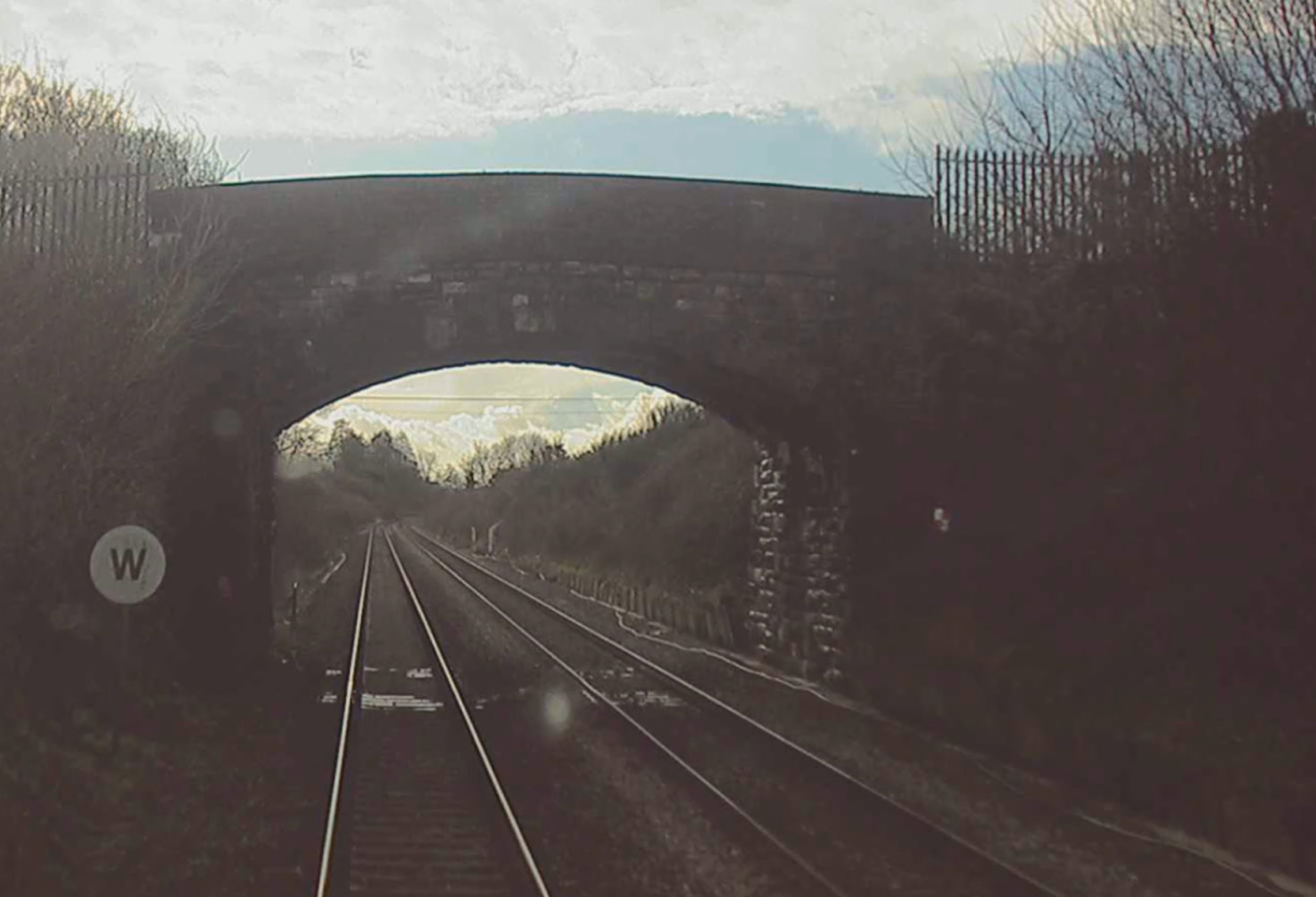
You are driving the passenger train at about 93 miles per hour (154 km/h). Your train approaches a railway footpath crossing near a village in the countryside. Your train reaches a ‘whistle board’, positioned 580 metres ahead of the footpath crossing so you can sound the train’s horn set to warn pedestrians that your train is fast approaching.
You next see a pedestrian on the footpath crossing in front of your train. You now repeatedly sound the train horn to urgently warn the pedestrian of your train’s imminent arrival at the crossing.
The pedestrian on the crossing then becomes aware of your train but, for some reason, continues to cross into your train’s path.
*
This is what happened when Shirley Pope was struck by a passenger train and fatally injured at the Pewsey rail footpath crossing in Wiltshire on 26 February 2025.
Pope, aged 82, was walking her dog on a lead at the time of the accident. The dog was also fatally injured.
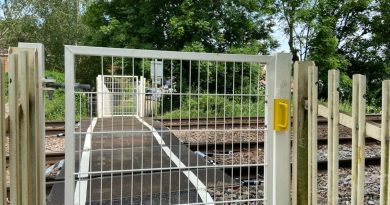
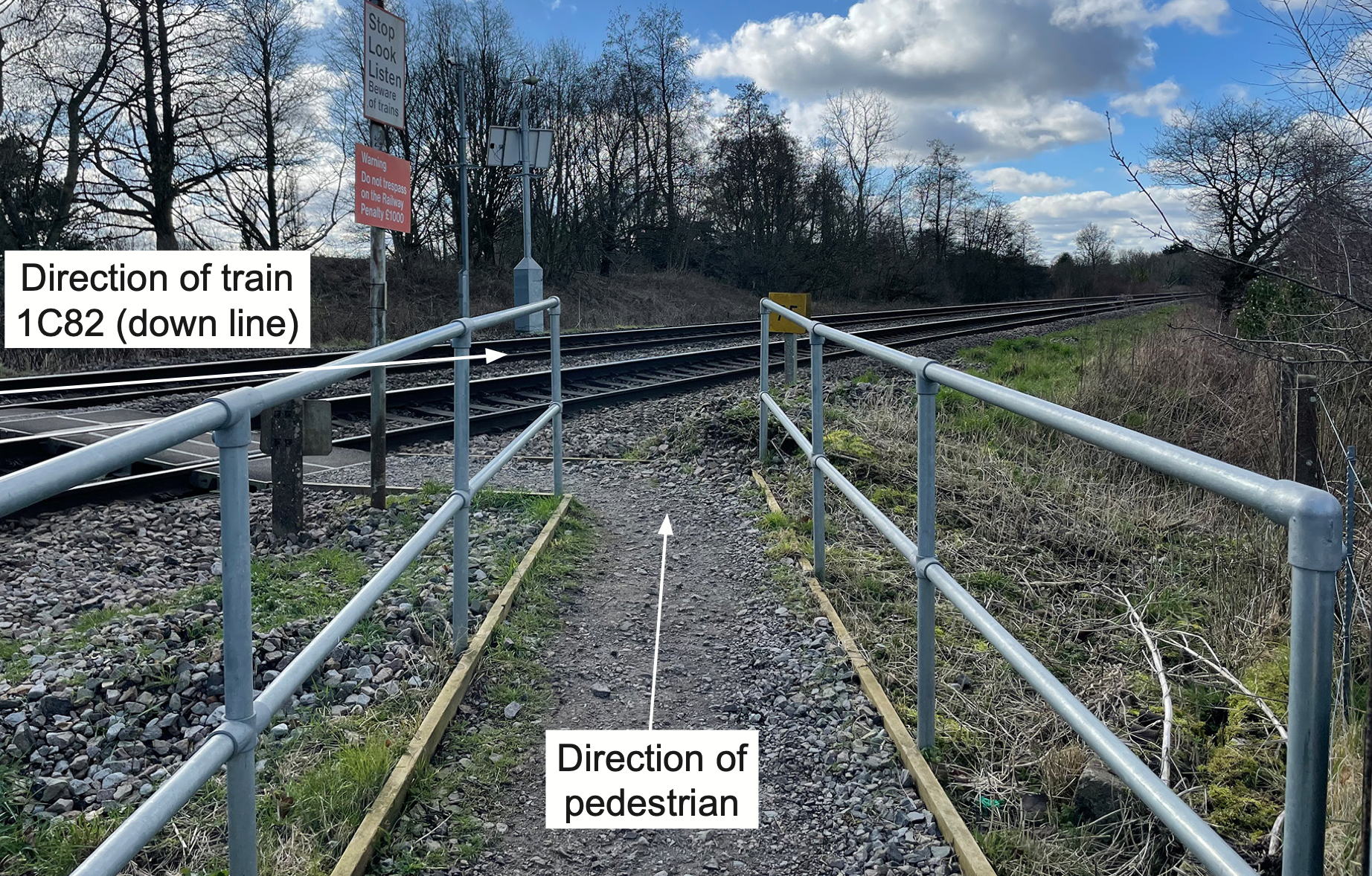
According to an investigation report, Shirley Pope had used the Pewsey crossing (above) between four and five times per week since September 2024.
Her regular morning and afternoon walks typically lasted around 45 minutes. Witnesses told investigators that Shirley Pope was ‘independent and capable’ and had no impaired mobility or cognition. However, she had hearing loss and was prescribed hearing aids for both ears.
She was wearing a hearing aid in her right ear only but not the left ear that was closest to the approaching train. She also wore a woollen hat that might have been covering both ears.
*
*
An investigation by the Rail Accident Investigation Branch (RAIB) leads to a report, published over a year later, on 7 May 2026. The RAIB report concludes ‘the accident happened because the pedestrian, who had hearing loss, was probably unaware that the train was approaching when they decided to enter the crossing’.
The RAIB suggests the pedestrian did not hear the train’s warning horn because the horn was ‘not clearly audible’ to the pedestrian, probably because of the pedestrian’s hearing loss.
However, the RAIB says the fact she could not hear was also likely due to the ‘reduction in sound level of the warning horn over the distance between the whistle board and the crossing’. The RAIB states this distance, at about 580 metres from the crossing, was ‘longer than permitted by guidance from Network Rail’, the body responsible for level crossing risk assessment and safety.
*
Pedestrians cannot always decide to safely cross this type of footpath crossing just by looking for an approaching train, or a second train coming, because some crossings offer only limited sighting.
This is why Network Rail provides signs for train drivers, known as ‘whistle boards’, instructing drivers to sound their train’s warning horn.
This ‘audible warning’ horn alerts pedestrians to the approach of trains. These horns only work effectively if pedestrians can hear them – and that ability depends partly on the distance and position of the ‘whistle board’ from a footpath crossing.
The Royal National Institute for Deaf People charity has reported over 18 million people in the United Kingdom are deaf or have hearing loss, including an estimated 2.4 million adults with hearing loss severe enough they cannot hear most conversational speech.
The RAIB’s investigation report also cites, as a factor, the ‘level of environmental noise near the crossing’. Shirley Pope might have been unable to hear the train’s warning horn because of ‘weather noise’ that may have affected the way the sound of the horn travelled from the ‘whistle board’ towards Pewsey crossing.
*
You might still though be thinking the death of Shirley Pope – and the trauma experienced by the train driver and the assessor – remains an isolated tragedy. However, during 2025-26, the RAIB has been investigating the deaths at footpath crossings of Jaiden Shehata (at Bourneview), Josh Travis (Chestnut Grove), and an un-named young person at Bottesford. (See London Intelligence, March 2026).
Pedestrian fatalities at footpath crossings have persisted despite Network Rail’s repeated pledges to improve its risk assessment and management of such crossings ever since the deaths of Charlotte Thompson and Oliver Bazlinton in December 2005.
A passenger train hit and killed the two friends at the Elsenham crossing in Essex. Network Rail had previously assessed Elsenham as dangerous in 2002 but failed to render the crossing safe; and – after the ‘accident-waiting-to-happen’ happened – Network Rail tried to cover up the existence of its 2002 risk assessment.
The pre-accident assessment and subsequent cover-up was only revealed in 2011. Network Rail was convicted for breaking health and safety law in 2012 and fined £1 million.
*
Network Rail, according to the RAIB, still manages 1,336 rail footpath crossings – about one quarter of all level crossings of which there are different types, including those where vehicular traffic crosses railways.
Of these footpath crossings, 753 feature ‘whistle boards’; and, of those, 376 suffer from ‘insufficient sighting distance’ of trains approaching from either direction.
Shirley Pope was killed at Pewsey, one of 98 crossings on Network Rail’s Western route with ‘whistle boards’. Of these, 37 do not give pedestrians ‘sufficient views’ of at least one approaching train.
RAIB identifies several learning points from Pewsey, including one of which relates to Network Rail staff ‘understanding and applying relevant standards and guidance’ when assessing risks at footpath crossings.
The RAIB also notes – significantly perhaps – that at the time of the accident Network Rail’s Western route Level Crossings Manager carried a workload that included being responsible for some 75 footpath crossings.
RAIB makes six recommendations to Network Rail in the long aftermath of Shirley Pope’s death. The first calls on Network Rail to identify and implement ‘appropriate risk mitigation measures…where whistle boards may be an unsuitable control measure’.
Secondly, Network Rail should control in the short term risks to crossing users with hearing loss, or who are deaf. Thirdly, the RAIB recommends Network Rail ‘review…the continued use of whistle boards at footpath crossings’.
*
Fourthly, the RAIB says Network Rail should ‘seek to ensure’ it ‘aligns its approach to level crossing standards with its wider standards and control management framework’.
Fifthly, it recommends Network Rail ‘aligns its management assurance of crossing risk assessments with its other assurance activities’.
Recommendations four and five infer the RAIB believes Network Rail still needs to upgrade its ‘risk assessment and management’ of railway crossings, including pedestrian footpath crossings, to match its efforts to safely manage other parts of the United Kingdom’s railway infrastructure.
Finally, the RAIB recommends Network Rail ‘considers the wider safety impact of closing public rights of way when making decisions around managing its assets’. This stems from people complaining to Network Rail and Wiltshire County Council about the closure of a nearby footbridge over the railway that had increased the likelihood of pedestrians – like Shirley Pope – of having no option but to use the Pewsey crossing.
*
Network Rail, as part of its remit, rightly educates young people about the dangers of playing near railways and at crossings. It emphasises that ‘it can take a train the length of twenty football pitches to come to a stop’. But misuse is a separate issue to risk assessment and mitigation at footpath crossings.
However, you could still be thinking surely it is down to each individual to make up their own mind and decide when it is safe to use a footpath crossing; and this is true, up to a point. As users of footpath crossings we look and listen for approaching trains at the crossing’s ‘decision point’ – a rail industry term for a two metre distance from the nearest track.
But if we do make a decision at that point that puts ourselves in danger – for whatever reason – the RAIB says research into previous accidents suggests that danger rapidly increases in the next few moments. Faced with a split-second decision, the research suggests we can critically become unable to decide whether to keep on crossing, stand still, or try to go back the way we have come.
The tragedy of Shirley Pope shows the speed at which in these moments things can rapidly go wrong for us as pedestrians.
Rail experts say we should expect Network Rail – and the regulatory Rail Safety and Standard Board – to mitigate every risk as much as is possible. These taxpayer-funded bodies should offer us as pedestrians – and train drivers – every feasible protection.
Ultimately, this is Network Rail’s responsibility; and for any failures in relation to footpath crossings Network Rail must expect to be held truly accountable.
Notes
- Class 800 trains run at higher speeds between major cities and regions on parts of the UK’s rail network.
- The Rail Accident Investigation Branch is independent of the rail industry.
- The Rail Safety and Standards Board regulates and researches safety standards at level crossings.
- Network Rail owns the rail network of England, Scotland, and Wales, and manages risk, including at most level crossings.
- The Royal National Institute for Deaf People is a charity working for people who are deaf and/or having hearing loss and tinnitus.
- Top image shows where a pedestrian would approach the Pewsey rail footpath crossing (Source: RAIB, May 2026).
*
© Paul Coleman, London Intelligence ® London, May 2026.